
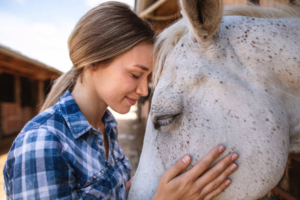
 For many years as a therapist, I have been gradually learning about this form of treatment. I was lucky enough to have gotten to participate in three instances of Equine-assisted therapy back around the year 2000. At that time I knew nothing about it, until finding out that an intern working in my agency had horses and was studying this unusual way to help people. She asked a few of us to come out to her ranch to see what this technique was all about, and she asked me to meet her for a couple sessions without my colleagues. It was overall a wonderful experience.
The one that I learned the most from worked like this: my friend who had the horses (it was just she and I that day) asked me to try and figure out how to get the horse to walk forward, but she didn’t tell me how to do it. The task involved me having to figure this out between the horse and myself. She was standing next to the horse and I was standing about 12 feet in front of the horse. I tried a couple things like talking to it and encouraging it to walk toward me, but all my talking and encouragement did not work. The horse just stood there looking at me. Finally, and I don’t remember how I figured this out, I walked over and stood next to the horse, shoulder to shoulder, and then when I walked forward the horse walked with me.
This was a tremendous lesson. I realized that the horse is not going to walk toward me when I am standing in its way, essentially blocking its path. The horse and I didn’t know each other. It was like a first interview with a client who doesn’t know me and doesn’t know what to expect from me. The therapeutic relationship has to be built slowly and there has to be trust. Just like with people! I realized that therapy may not work with people if I am standing in their path, and that they are more likely to move forward if I am walking next to them.
Equine-assisted therapy (EAT) is a recognized and evidence-based therapeutic modality that uses structured interactions between individuals and horses to support emotional, cognitive, and physical development. For both children and adults, this form of therapy offers unique benefits rooted in the horse’s sensitivity, responsiveness, and nonjudgmental presence. Doesn’t that sound great?
For children, especially those with developmental delays, autism spectrum disorder, or emotional challenges, EAT provides a calming and engaging environment that encourages communication and builds confidence. Activities such as grooming, leading, and riding can improve motor coordination, balance, and sensory regulation. Horses respond honestly to body language and tone, which helps children strengthen social awareness and emotional regulation in ways that traditional clinical settings may not easily achieve. And just being around horses is therapeutic in itself, as some of you may know.
Of course, adults also benefit from the experiential nature of equine-assisted therapy. Individuals coping with trauma, anxiety, or depression often find that working with horses promotes trust, grounding, and emotional processing. The physical aspect of riding can improve core strength and mobility, while the relational aspect of EAT fosters mindfulness and self-reflection.
Because horses mirror human emotions and require clear, calm communication, EAT supports the development of resilience, self-esteem, and interpersonal skills, and spending time with horses tends to lower anxiety and relieve depression, because it gets people out of their heads. As a complementary therapy, it continues to grow in popularity for its holistic approach to healing and personal growth. And there are a number of EAT programs available in the Capital District.
By: Terry McMaster, LMSW, EAP Counselor